Spott vs Invenias
Discover the ideal ATS/CRM solution for your business as we compare the top contenders for you in our head-to-head series
Invenias has been the executive search industry's default platform for nearly two decades. Acquired by Bullhorn in 2018, it serves 700+ firms and 10,000+ users globally. Its architecture is built entirely around Microsoft Outlook and a desktop application - a design philosophy that made sense when the product launched, and one that still appeals to firms deeply embedded in the Microsoft 365 ecosystem.
But the recruitment technology landscape has shifted dramatically since 2018. AI-native platforms now handle semantic matching, auto-generated notes, candidate enrichment, and intelligent workflow management as core functionality. Invenias has responded with a basic AI Copilot that drafts emails and categorises assignments - features that most recruiters already access through ChatGPT. The desktop-first architecture remains unchanged. The web version, Invenias Essentials, still lacks full feature parity. And users consistently report that the platform has seen limited development since the Bullhorn acquisition.
Spott was built on a fundamentally different premise: AI should be the foundation of a recruitment platform, not a feature bolted onto a legacy desktop application. Every capability - matching, note-taking, enrichment, candidate reports, outreach - runs on a single data model where context flows between every interaction. And unlike Invenias, Spott is not limited to executive search. It serves permanent placement, contract, and temporary staffing models from the same platform.
This comparison breaks down where each platform genuinely wins, where each falls short, and which type of firm each one is actually built for.
I've been with Invenias for over 10 years, but the platform is no longer actively updated. We depend on another vendor for basic functionality and are completely missing the shift to AI.
Bjorn A.
Owner · G2 Reviews
Desktop-First vs AI-Native Platform
The core difference between Invenias and Spott is architectural, and it affects every feature downstream.
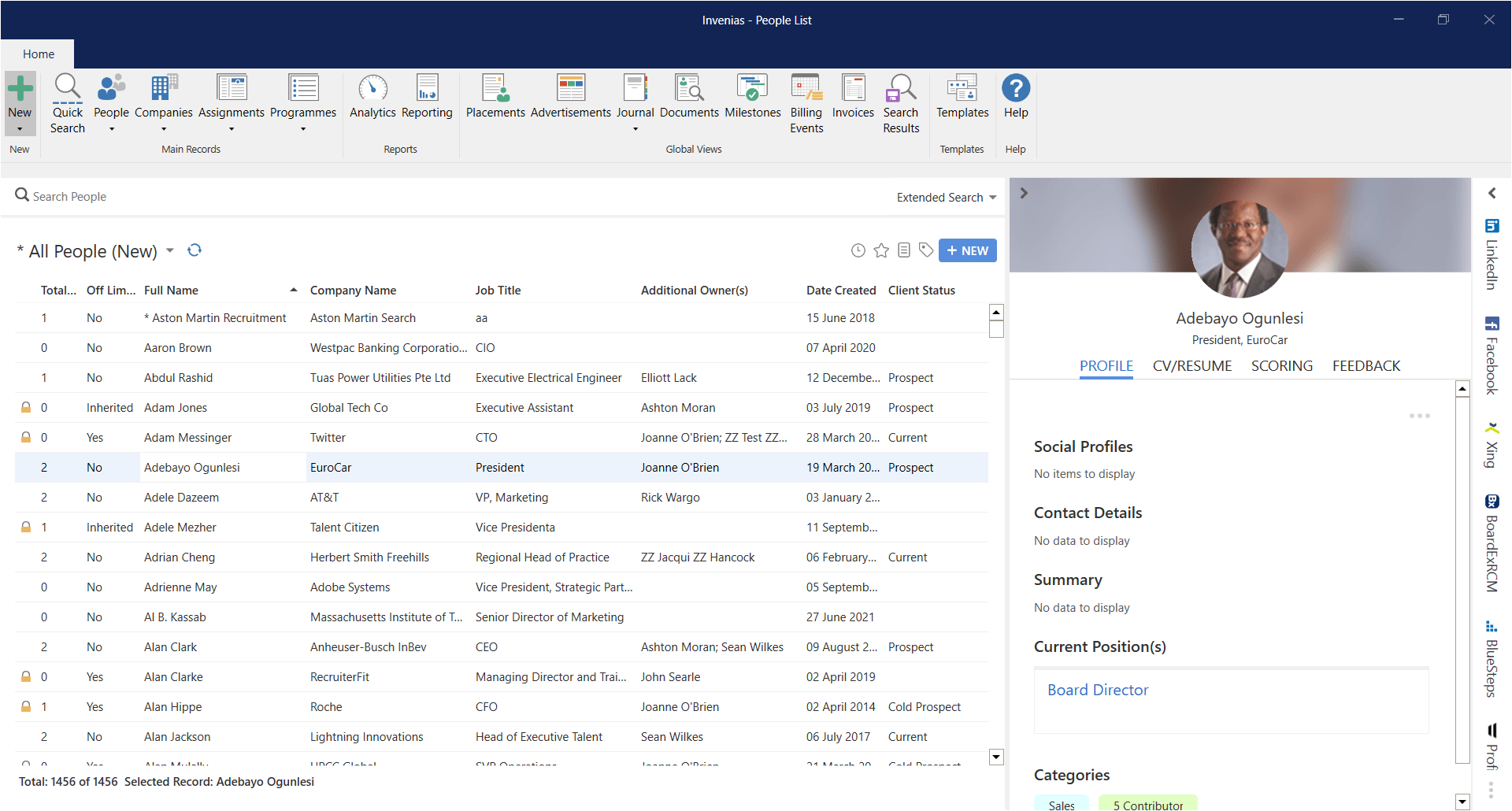
Invenias' approach: Invenias is a traditional desktop application built around Microsoft Outlook and the broader Microsoft 365 ecosystem. The platform was designed in an era when desktop software was the standard for enterprise tools. It offers a secondary web version called Invenias Essentials, but Essentials does not replace the desktop application - it lacks full feature parity and was introduced primarily for on-the-go access to a subset of functionality. There is no Mac support. The system requires a Windows desktop installation, and its performance is tightly coupled to the Outlook client running alongside it.
Since Bullhorn acquired Invenias in 2018, the platform has seen limited development. As one G2 reviewer put it: the product is not being developed, with almost no new integrations available. The most significant addition has been an AI Copilot that generates email drafts and categorises assignments - basic capabilities that do not address the deeper architectural limitations.
Spott's approach: Spott is a cloud-native, AI-first ATS/CRM where AI is the data model, not a feature added on top. Profiles self-update from every interaction - calls, messages, LinkedIn activity, and enrichment sources. Matching is semantic and contextual, drawing from the full history of candidate interactions. Auto-notes, candidate report generation, data enrichment, and workflow intelligence are all native to the platform. No desktop installation required. Works on any device, any browser, any operating system.
The architectural difference has a compounding effect: every feature Spott ships makes every other feature smarter because they share the same data model. In a desktop-first architecture like Invenias, each new capability is constrained by the limitations of the underlying platform.
At-a-Glance Comparison
Basic Copilot vs Native Intelligence
This is where the architectural gap between Invenias and Spott becomes most visible.
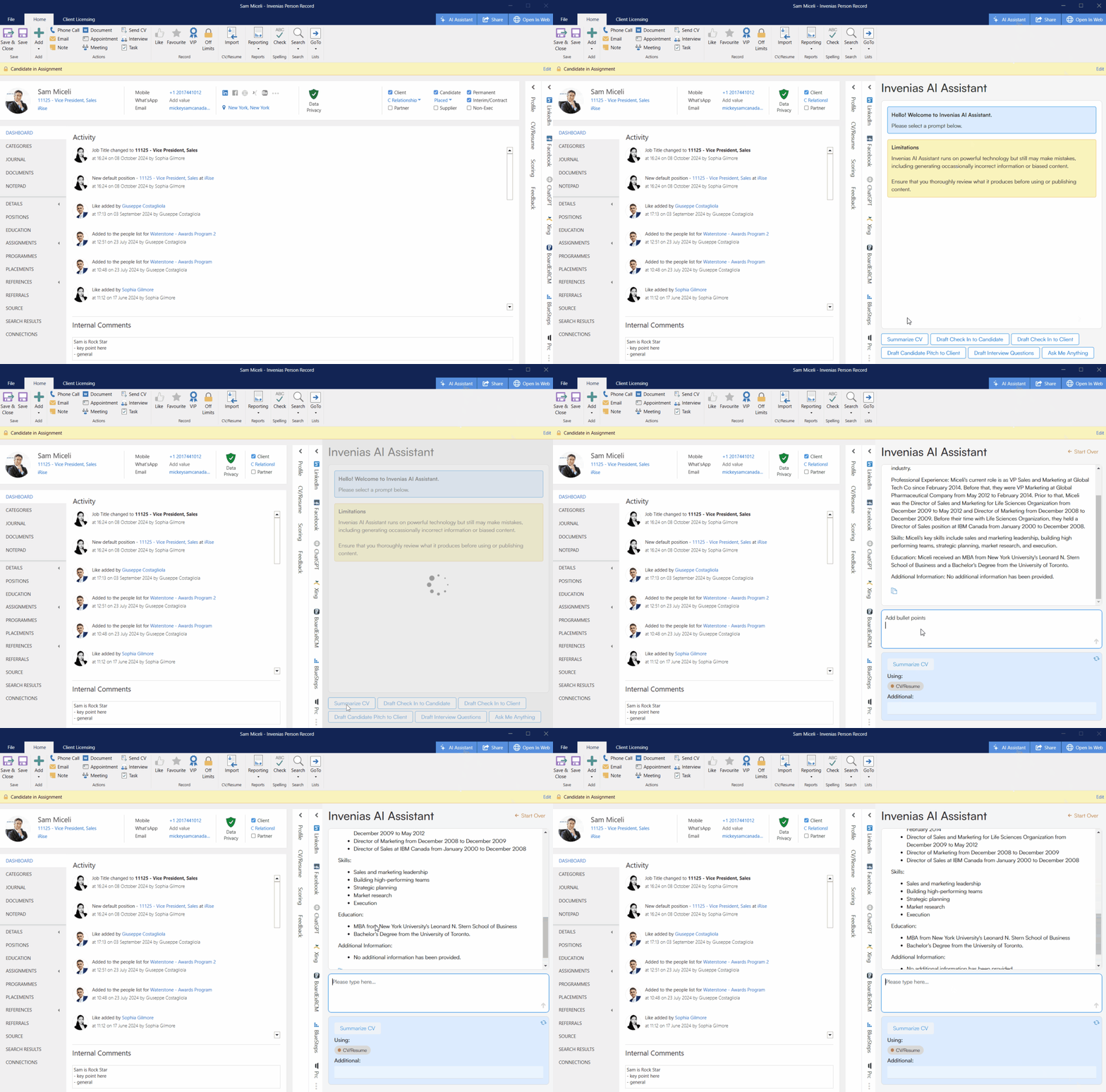
Invenias: In mid-2024, Invenias introduced an AI-powered Copilot integrated into both desktop and web applications. The Copilot offers one-click prompts to draft personalised emails and summaries based on Invenias data, and can automatically categorise assignments based on company information. Users can choose between OpenAI and Azure OpenAI as the underlying provider for data security preferences.
However, these capabilities represent the most basic layer of AI in recruitment. The Copilot drafts emails - something recruiters already do with ChatGPT. It does not offer semantic candidate matching. It does not auto-generate notes from calls or meetings. It does not build AI-powered candidate reports. It does not enrich profiles automatically. As one G2 reviewer noted: "We depend on another vendor for basic functionality and are completely missing the shift to AI."
There is also no integration path to Bullhorn's more advanced Amplify AI platform. Despite being part of the Bullhorn catalog since 2018, Invenias has not benefited from Bullhorn's broader technology investments in the way users expected. As one Capterra reviewer observed: "When Bullhorn acquired Invenias we were excited about the potential for some of the Bullhorn features being worked into Invenias, but that doesn't seem to have happened."
Spott: Every AI capability is native and included in the subscription price. Semantic matching understands context from calls, notes, messages, and CVs - not just keywords on a profile. Notes auto-generate from every call and meeting. Candidate reports build from transcriptions, CVs, and job descriptions with one click. Data enrichment runs continuously. Workflow intelligence surfaces what needs attention next. No add-ons, no separate contracts, no per-action fees.
"The precision of the AI matching stood out immediately." - Kristof Stevens, United Consulting
Bottom line: Invenias offers a basic email-drafting Copilot. Spott delivers purpose-built recruitment AI natively across the entire workflow - matching, notes, enrichment, reports, and intelligence.
Search and Candidate Matching
For executive search professionals, the ability to quickly surface the right candidates from your database is everything. Research shows that up to 70% of placements come from candidates already in your system rather than newly sourced ones.
Invenias: The platform offers a traditional database query system with Boolean operators (AND, OR, NOT), field-specific filtering, and keyword matching. While comprehensive in structure, the system relies heavily on precise user input. You need to know exactly what terms to search for, and the system will only return exact matches against those terms. There is no AI-powered matching capability - no way to say "find me candidates like this person" or "who in my database fits this role" and get intelligent results.
Spott: Search is semantic and contextual. When a recruiter searches for a candidate, Spott draws from every data point: CVs, call transcripts, email exchanges, notes, LinkedIn data, and enrichment sources. The system understands intent, not just keywords. A search for "senior finance professional with change management experience" surfaces candidates who discussed those topics in calls or whose career trajectory suggests the fit - even if those exact words do not appear on their CV.
"Spott claimed the top spot" among 200+ tested ATS solutions - Guillaume Lepercq, FreelanceRepublik
Bottom line: Invenias relies on keyword search that requires precise input. Spott's semantic search understands context across every interaction - the difference between searching records and understanding candidates.
Data Quality and Enrichment
Executive search databases are particularly vulnerable to data decay. Senior professionals change roles, update board positions, move between geographies. A database that is not actively maintained becomes a liability.
Invenias: Tagging and labelling your database is a manual process. The system typically works with a fixed set of 20 to 30 predefined tags. This creates a constant tension: stick to a rigid set of tags (limiting flexibility) or allow everyone to add tags freely (degrading consistency over time). There is no auto-enrichment, no automatic profile updating from external sources, and deduplication requires manual effort. The result is databases that slowly degrade in quality as records go stale.
Spott: Spott works with AI-fillable columns. Define which industries, skills, or attributes you want to tag, and the AI goes through your entire database to assign labels accordingly. Want to add or remove a label, or add a new column entirely? It takes a couple of clicks - ensuring you always have relevant labels at hand for filtering, applied consistently across all candidates. Profiles auto-update from every interaction. When a candidate mentions a new role in a call, the profile reflects it. When enrichment data surfaces a job change, it updates immediately. Strict native deduplication prevents the record bloat that plagues legacy systems.
Bottom line: Invenias requires manual data maintenance that degrades over time. Spott's data model is self-improving - every interaction makes the database more accurate and more useful.
UX: Desktop vs Modern Web
The most expensive software is the software your team does not use. For executive search firms, recruiter adoption determines whether an ATS investment delivers returns.
Invenias: Invenias is a desktop application that runs on Windows and integrates tightly with Microsoft Outlook. There is no Mac support. The web version - Invenias Essentials - was introduced for on-the-go access but does not replace the desktop client due to missing features. Users consistently report performance issues: the system often lags, taking several seconds to process basic actions like opening candidate profiles or running searches. One reviewer described it as "INCREDIBLY slow" with 3-second reaction times for simple clicks. The UI has been described as "close to unacceptable" and "not intuitive" with a "cluttered" interface.
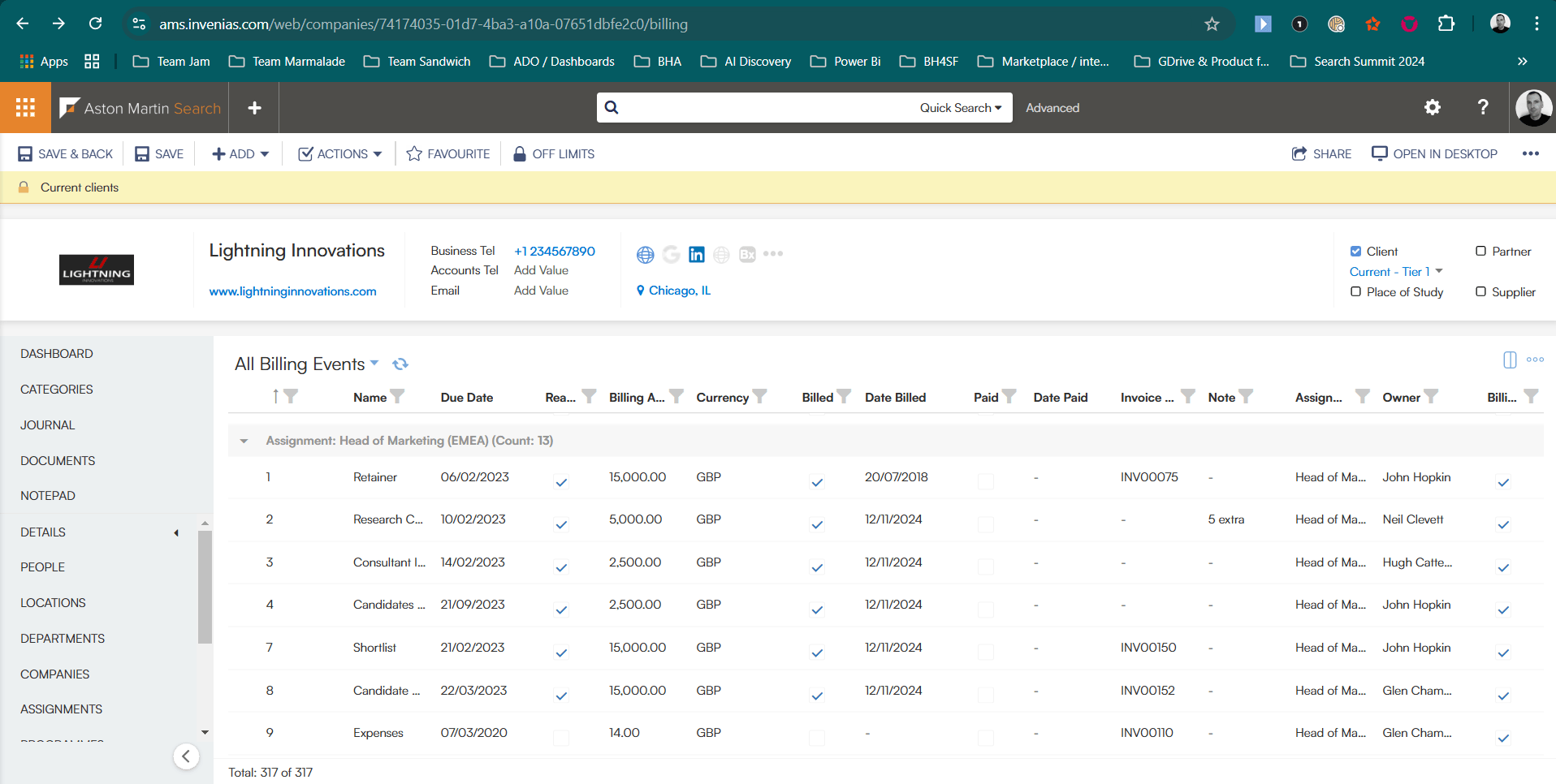
Adding candidates to the database is described as "extremely time consuming" with friction at every step. There is no Zapier integration and no alternative way to automate tasks - meaning a lot of duplicate process work for recruiters who want to connect Invenias to other tools in their workflow.
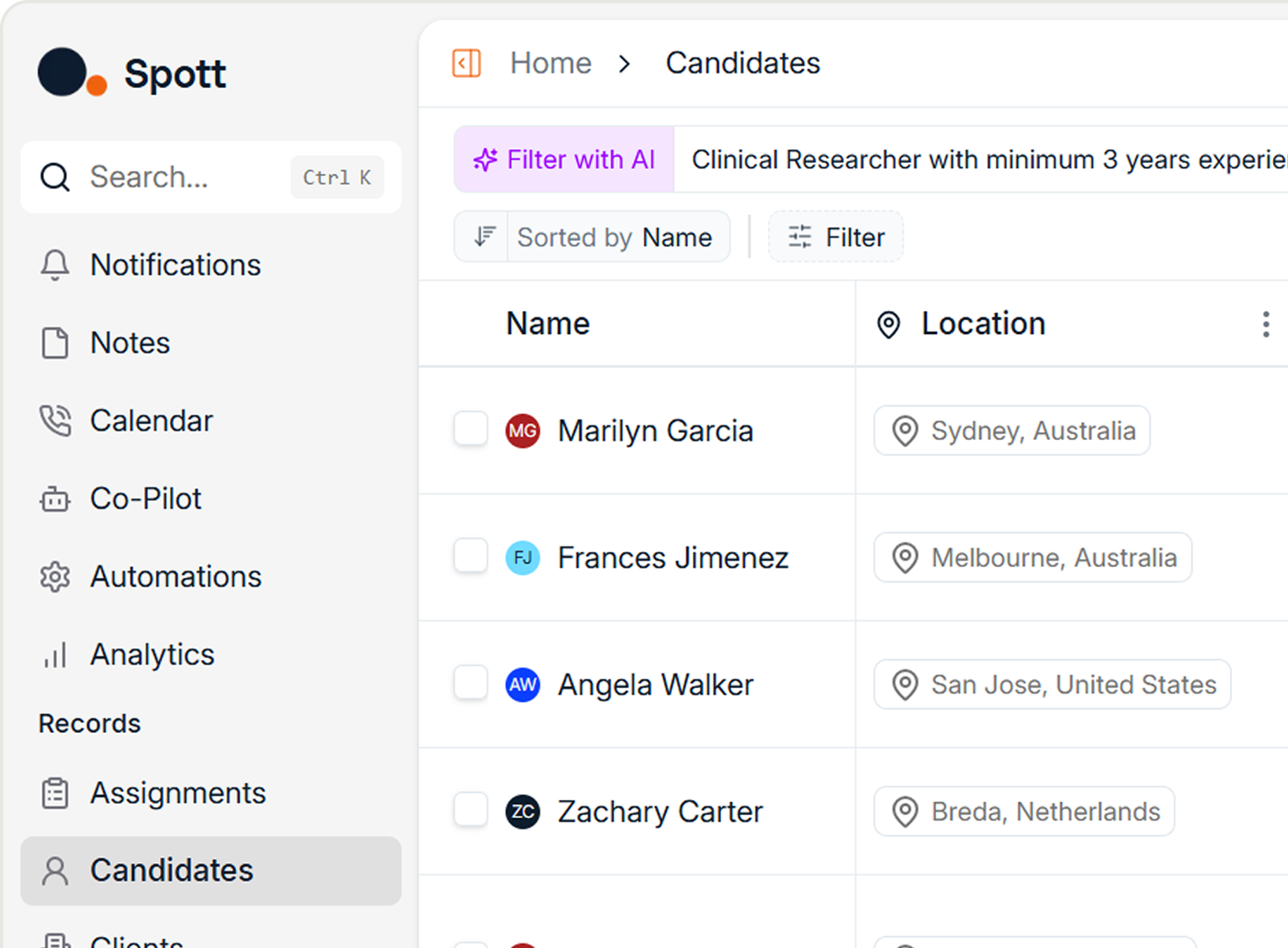
Spott: Purpose-built for recruiters on modern web technology. Drag-and-drop views, kanban boards, saveable filters, custom attributes, and an @badge notification system that surfaces priorities without hunting through menus. Recruiters onboard in days, not weeks. The interface works on any device, any browser, any operating system - no desktop installation, no Windows dependency, no Outlook requirement.
"The speed to share top candidates with clients is crazy. It makes the whole process feel effortless." - Savanna, McIlwain Solutions
Bottom line: Invenias is a desktop application with performance issues and no Mac support. Spott is a modern web platform that recruiters actually want to use - and that is where adoption and ROI begin.
Client Presentation and Reporting
Executive search is a high-touch, relationship-driven business. The quality of candidate presentations and progress reporting directly reflects on your firm's professionalism.
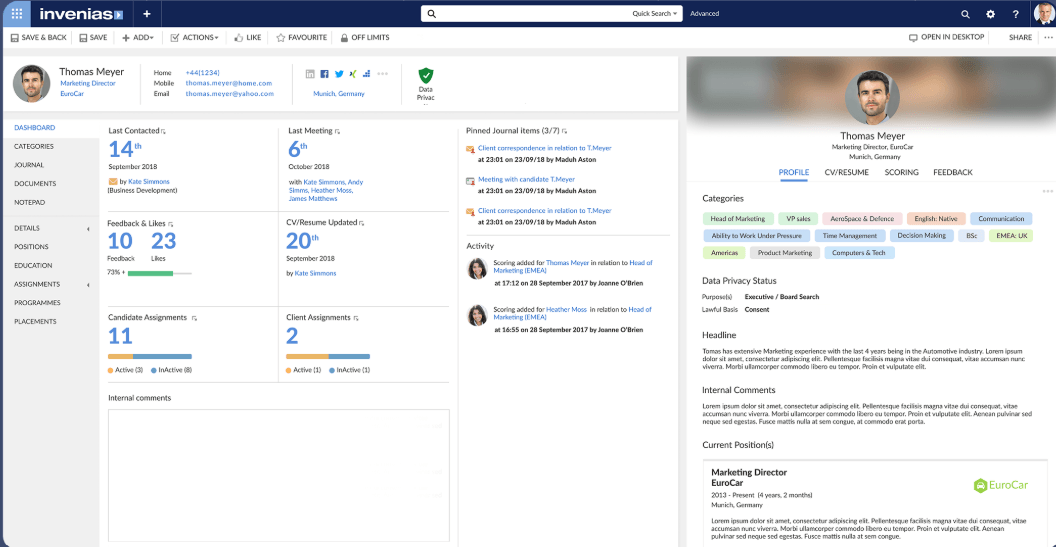
Invenias: The platform offers branded client deliverables built through Microsoft Word templates. You can create longlists, shortlists, and candidate summaries in a format that matches your firm's branding. For analytics and reporting, Invenias includes a basic analytics layer, but more advanced dashboards and visualisations require Microsoft Power BI integration - which costs an additional $240/year for a Power BI Premium subscription. This is a significant added expense for something that many modern platforms include as standard.
Spott: Candidate reports are AI-generated from transcriptions, CVs, and job descriptions with one click. Reports can be exported as branded Word or PowerPoint documents and shared directly with clients. CV reformatting is native. Analytics dashboards are included in all plans - no separate subscription required, no Power BI dependency.
Bottom line: Invenias offers solid template-based deliverables but gates advanced analytics behind an extra subscription. Spott generates AI-powered reports and includes full analytics natively.
The Real Cost Comparison
Pricing in executive search software is rarely as straightforward as the per-user number suggests. The total cost of ownership includes the tools you need to add on top.
Invenias: License fees range from $129 to $189 per user per month, placing it at the higher end of the executive search ATS market. On top of that base cost, firms typically need to budget for Power BI Premium ($240/year) for meaningful analytics and reporting. Because Invenias lacks native AI matching, auto-notes, and advanced automation, firms that want these capabilities need to add external tools - each with its own contract and cost. The desktop-only architecture also limits where and how teams can work, creating productivity constraints for firms with remote or travelling consultants.
Spott: $119-179/user/month with every AI feature included. Semantic matching, auto-notes, call transcription, candidate report generation, data enrichment, analytics, and outreach campaigns are all part of the subscription. No add-on modules. No per-feature upsells. No separate analytics subscription. Migration is included and completed in 4 weeks.
Bottom line: Invenias' sticker price is competitive, but the real cost climbs when you add Power BI, external AI tools, and the productivity cost of a desktop-only platform. Spott's all-inclusive pricing means firms know exactly what they are paying.
When Invenias Is Still a Reasonable Choice
- Your firm is deeply embedded in the Microsoft 365 ecosystem and values Outlook-native workflows where email, calendar, and candidate data live in the same environment.
- You have a small, senior team that is comfortable with the existing desktop interface and sees no reason to change a workflow that has worked for years.
- You run exclusively retained executive search with no plans to expand into permanent placement, contract, or temporary staffing models.
- Your compliance and reporting requirements are straightforward enough to manage without advanced AI-powered analytics.
- You have already invested heavily in Invenias and the switching cost - even at just 4 weeks - outweighs the productivity gains for your specific team size and workflow.
Where Spott Wins
- You want AI that works across your full workflow - not just email drafts. Semantic matching, auto-notes, enrichment, candidate reports, and workflow intelligence are all native.
- You need a modern web platform your team can access from any device, any location - without a Windows desktop installation or Outlook dependency.
- You are expanding beyond pure executive search into permanent placement, contract, or temporary staffing and need one platform that handles all models.
- You want analytics included - not gated behind a $240/year Power BI Premium subscription.
- You value fast migration and personal support. 4 weeks from decision to live, with direct Slack access to the product team.
- You want a platform that ships weekly - not one that has seen limited development since its acquisition in 2018.
Bottom Line
Invenias earned its position in the executive search market through 18 years of focused specialisation and deep Microsoft 365 integration. For small firms running retained search mandates within a tightly integrated Outlook workflow, it remains a stable and familiar choice.
But the gap between what Invenias offers and what modern recruitment technology delivers is widening. The desktop-first architecture, basic AI Copilot, lack of semantic matching, missing auto-notes, and dependence on external tools for capabilities that should be native - these are not minor gaps. They are structural limitations that compound over time as AI-native platforms continue to advance.
Spott was built for the way executive search - and recruitment more broadly - works today: across channels, with full context, at speed. AI-native from day one, not retrofitted onto a desktop application from another era.
When Bullhorn acquired Invenias we were excited about the potential for some of the Bullhorn features being worked into Invenias, but that doesn't seem to have happened. Compared to AI-powered software for the executive search industry, Invenias is starting to feel dated.
Leanne M
MD in Recruiting · Capterra Reviews
Ready to see the difference? Book a demo and we will show you how your team can make more placements, faster - without the add-on tax.

Frequently Asked
Invenias remains a stable platform with strong Microsoft 365 integration that some executive search firms rely on for day-to-day operations. However, users report that the platform is no longer actively updated and is completely missing the shift to AI-driven recruiting. It runs primarily as a desktop application with a secondary web version called Invenias Essentials that lacks full feature parity. Firms that need modern AI matching, web-based access, or advanced automation will find Invenias increasingly outdated.
Invenias pricing ranges from $129 to $189 per user per month, placing it at the higher end of the executive search ATS market. Analytics functionality through Power BI Premium costs an additional $240 per year, a feature that many competing platforms include as standard. Given that users describe limited platform development since the Bullhorn acquisition, firms should carefully evaluate whether the pricing reflects the current value delivered. AI-native alternatives like Spott include analytics and AI matching without requiring costly add-ons.
Invenias relies on a desktop-based architecture that feels slow when opening profiles or running searches, and its web version lacks the full feature set. Its AI capabilities are limited to a basic AI Copilot for email drafting and assignment categorization, falling short of true semantic search or candidate matching. The platform lacks Zapier support, restricting integration options, and users depend on external tools for complex workflows. Development investment appears minimal since the Bullhorn acquisition, leaving the platform behind modern competitors.
Spott offers a modern, AI-native alternative to Invenias built specifically for recruiting workflows including executive search. Where Invenias limits AI to basic email drafting, Spott delivers semantic search, automated candidate matching, and conversation intelligence that captures context from every interaction. Spott runs entirely on the web with no desktop dependency and includes analytics as standard without Power BI add-on costs. Executive search firms can migrate from Invenias to Spott in approximately 4 weeks with AI-powered data migration.

Outp(l)ace everyone.
You can’t win tomorrow’s placements
with yesterday’s tools.
